
Review · SPAIN
Elda: El Bolón via ferrata with zipline and abseiling
A mountain challenge with a fast finish. Elda’s El Bolón route combines three linked via ferrata sections, hanging bridges, climbing walls, a zipline, and abseiling in a compact three-hour outing. I like the clear safety setup and the chance to try several types of mountain activity in one trip. I also like that guides provide photos and videos, so you can focus on the route instead of protecting your phone.
The main point to check is the zipline description. It is promoted as Alicante’s longest, but the information gives both over 1,000 meters and over 100 meters. Those figures do not match, so I would confirm the exact length before booking. The route may also feel demanding if heights make you uneasy.
Key points to know before you book
- Three via ferrata grades: The route links K1, K3, and K2 sections, so the difficulty changes as you go.
- A short approach: You walk about 10 minutes from the meeting point at the foot of the Sierra de Bolón to the route.
- A full equipment package: Your helmet, harness, and energy absorber are supplied, with a simple safety briefing before climbing.
- A mix of mountain obstacles: Expect vertical climbing, horizontal flanking, hanging bridges, a zipline, and abseiling.
- A small price for a full activity block: At $53 per person, the cost includes guides, equipment, insurance, photos, and videos.
- A strong safety record in the available feedback: A Dutch participant called it challenging and very enjoyable, while a father and son from Poland praised the organization and constant care.
Starting at the foot of Sierra de Bolón
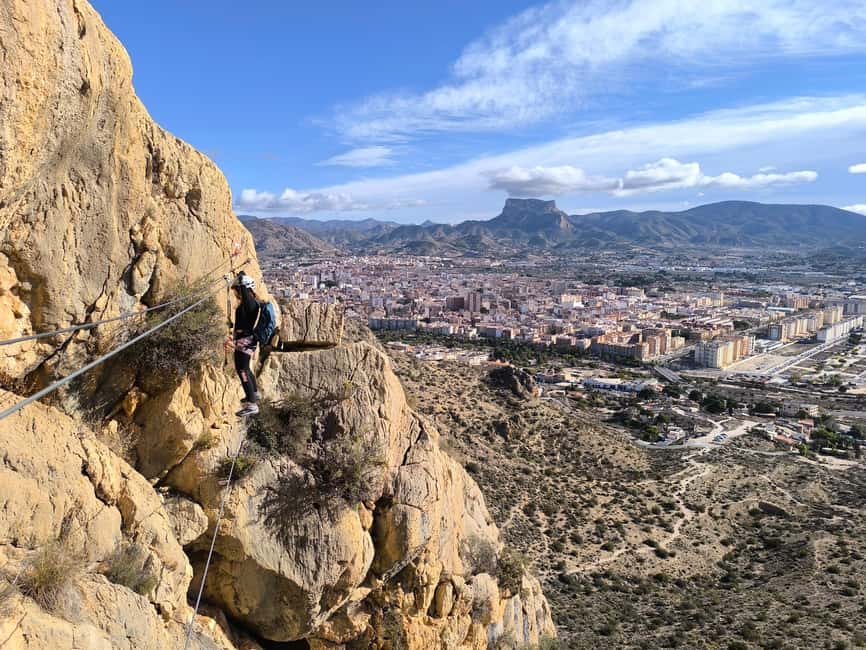
The outing begins at the foot of the Sierra de Bolón in Elda, within Spain’s Valencian Community. This meeting point keeps the start straightforward: you arrive, meet the professional guides, and prepare before the route gets serious.
The walk to the first climbing section takes about 10 minutes. That is useful because you do not spend half the activity hiking before reaching the main event. At the same time, you should wear comfortable clothes and suitable footwear for a short approach over mountain ground.
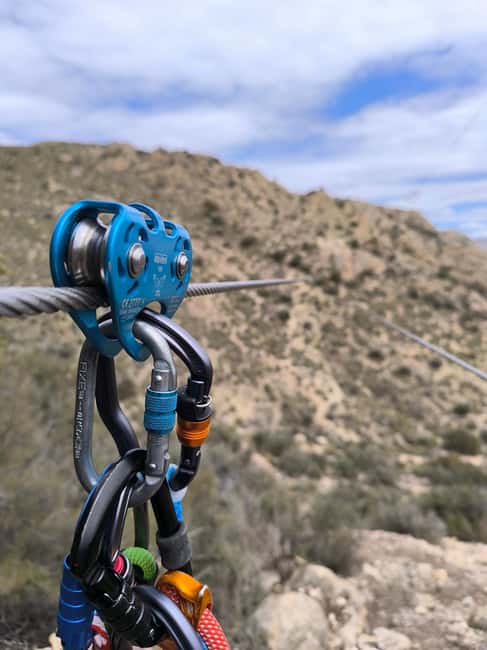
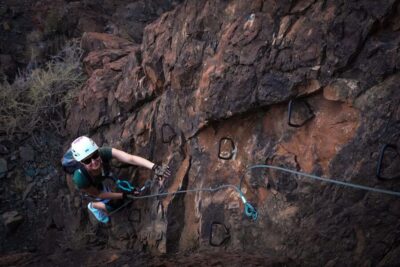
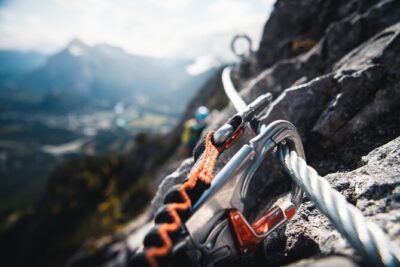
Your guide supplies a helmet, harness, and energy absorber. The equipment is not just handed over with a quick nod. The briefing explains how to use each piece in clear, simple terms, which matters if this is your first via ferrata.
A via ferrata uses fixed metal features and a safety cable attached to the rock. You clip into the lifeline as you move, allowing you to climb while staying connected to the route. The energy absorber helps manage a fall, but it does not remove the need to follow instructions carefully.
More Via Ferrata Routes in Spain
- Sant Feliu de Guixols: Climb Via Ferrata Cala del Molí
★ 5.0 · 253 reviews - Gran Canaria: Guided Via Ferrata Excursion
★ 4.9 · 198 reviews - Via Ferrata in Gran Canaria. Vertical adventure park. Small groups
★ 5.0 · 183 reviews
Three grades, one changing route
The route links K1, K3, and K2 sections. In the usual grading system, K1 is easier than K3, while K2 sits between them. The important practical point is that the route is not one steady level of effort.
You begin with an easier section that helps you learn the movement and equipment. Later, the K3 portion raises the challenge. This may involve more exposure, more effort, or more demanding climbing moves, though the supplied details do not specify the exact arrangement of the three grades.
That change makes the activity more interesting than a single short ladder. You get time to find your rhythm, then face a harder passage, followed by a section that is less demanding than the peak difficulty. I like that structure for mixed groups because stronger participants get a real challenge without making the entire route advanced.
Still, K3 is worth taking seriously. You do not need to be an expert climber, but you should be comfortable with heights, fixed cables, and using your arms and legs to climb. Ask the guide for a clear explanation of the harder section before starting if you are unsure.
Climbing the first vertical wall
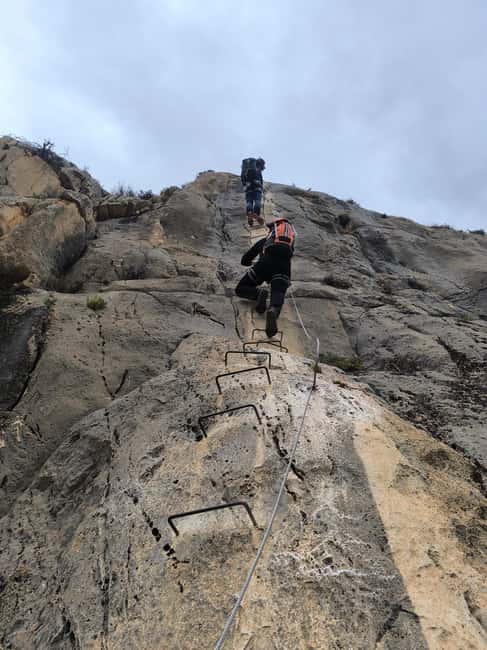
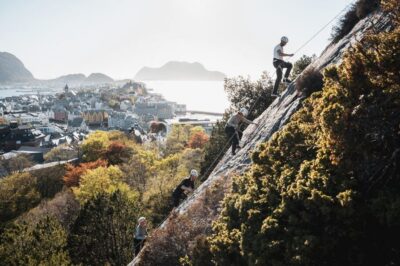
The first main obstacle is a vertical wall fitted with metal rungs. You clip into the lifeline, place your feet carefully, and climb rung by rung. The route description presents this as an approachable introduction, with the guide helping you gain height at a steady pace.
This is where the safety briefing becomes practical. You are not merely listening to instructions at the meeting point. You are using your carabiners and energy absorber as you climb, with the guide nearby to help you understand the system.
The wall gives you an immediate sense of height. You will feel the rock below you and the open space around you, but the fixed equipment provides a clear route to follow. If you have never tried a via ferrata, this first climb can help you decide how much of the experience suits you.
Keep your pace calm. You do not need to race the people ahead. Let your arms rest when possible, use your legs to push upward, and tell the guide if you need a moment. The three-hour schedule allows time for the activity, but the exact pace depends on the group.
The horizontal flanking section and its views
After the initial climb, the route may continue with a horizontal flanking section. This is described as a fun passage that gives you a different perspective from the vertical wall.
Horizontal sections often test balance and route awareness more than raw climbing strength. You move across the rock instead of simply going upward, staying clipped to the cable while working through the fixed features.
This part can be especially rewarding if you want views without spending the entire activity on a ladder. The exact outlook is not specified, so I would not book this expecting a particular panorama. Still, the change in direction should make the route feel varied.
The guide decides with the group whether to continue through this section. That suggests some flexibility in the outing, but you should ask how the choice affects the full route, the zipline, and the abseiling. The supplied information does not explain if these activities are included in every version of the route or where they fit in the sequence.
More Zip Lines in Spain
- Climbing + Zipline + Via Ferrata + Cave. Adventure route in Gran Canaria
★ 5.0 · 149 reviews - Agaete: Gran Canaria Coasteering. Marine Ferrata and Zipline
★ 5.0 · 38 reviews - Gran Canaria: Guided Via Ferrata and Zipline Adventure
★ 4.1 · 36 reviews - Caminito del Rey – Via Ferrata & Zip Line Adventure
★ 5.0 · 26 reviews
Hanging bridges, zipline, and abseiling
The headline attractions go beyond the metal rungs. The experience includes hanging bridges, a zipline, and abseiling, giving you several kinds of movement in one trip.
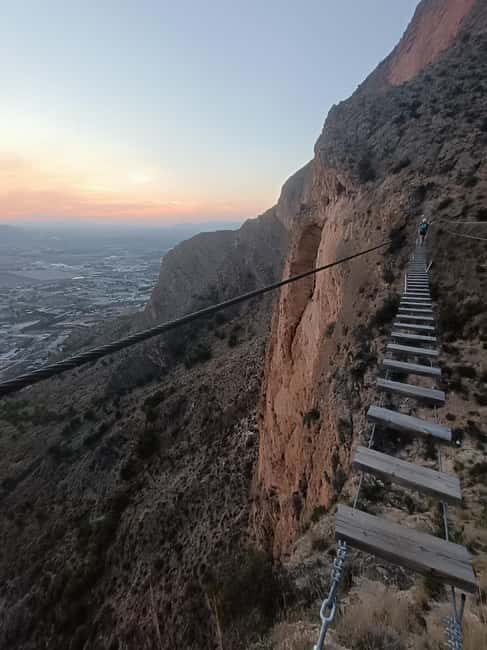
A hanging bridge adds a wobbly, exposed element. It can be more about nerve than strength, especially when the bridge moves under your feet. The fixed safety system and guide support are important here, so stay clipped in and follow the instructions rather than trying to make the crossing faster or more dramatic.
The zipline is promoted as the longest in Alicante and as more than 100 meters long, while another part of the description says over 1,000 meters. Since those figures conflict, confirm the current length with Masaventuras before you pay. Either way, the zipline is presented as a major part of the experience, not a minor extra.
Abseiling adds a controlled descent by rope. The available information confirms that it is part of the advertised activity, but it does not give the descent height, exact location, or technical details. Ask about those points if abseiling is the main reason you are booking.
This is one place where the three-hour duration offers good value. You are not paying only for a short climb or a single zipline ride. You are getting a linked activity that changes pace and technique several times.
Returning by a comfortable path
After the climbing section, a comfortable path leads back to the starting point. That return matters. A difficult hike out can take the shine off an otherwise enjoyable mountain activity, especially after using your arms and concentrating on safety.
The route description frames the return as a chance to enjoy the satisfaction of completing your first via ferrata. You may finish tired, but you should not need to repeat the technical climbing simply to get back to the meeting point.
Bring food and drinks for before or after the activity. They are not included, and the supplied guidance specifically asks you to carry them. There is no promise of a meal stop, so plan accordingly.
What the $53 price includes
At $53 per person, this is a fair price for a three-hour guided adventure, provided you value the full package. The cost includes professional guides, all listed via ferrata equipment, civil liability and accident insurance, entertainment, and photos and videos of the experience.
The equipment alone is useful for first-time participants. You do not need to buy or rent a helmet, harness, or energy absorber separately. Insurance also removes one practical concern, though it does not replace your responsibility to follow the guide’s instructions.
The photos and videos add value. Technical activities make it hard to take your own pictures safely, and carrying a phone while clipped to a cable is more trouble than it is worth. Having the guide document the outing lets you concentrate on the climbing and enjoy the memory later.
The price is less attractive if you are interested only in the zipline. In that case, compare the cost with a simple zipline activity. Here, you are paying for a guided route, several obstacles, safety equipment, and a mix of climbing and descent activities.
Guides, languages, and group comfort
Masaventuras provides live guides in English, French, Catalan, Portuguese, and Spanish. That range is helpful for international groups and families who do not all speak the same language.
Safety is the strongest theme in the available feedback. A father who completed the route with his son described the organization as excellent and said they felt safe and cared for throughout. That is useful information because via ferrata success depends as much on calm instruction as on the physical route.
The outing is set up as a group adventure. You should expect to share the pace with other participants, though the group size is not provided. If you prefer to move alone or at your own speed, ask about the group arrangement before booking.
The feedback also includes a Dutch participant who described the activity as challenging and very enjoyable. That combination is a fair description of what to expect. This is not a passive sightseeing trip, but it is designed to be guided and approachable rather than a self-led technical climb.
Who should book, and who should skip it
I would recommend this activity to adults, families with older children, and friends who want one active outing with several stages. The father and son booking shows that it can work well as a shared challenge, provided everyone is comfortable with heights and climbing.
It is also a good match for first-time via ferrata participants who want instruction and equipment included. The K1 opening section, clear briefing, and guide support give beginners a sensible starting point, while the K3 section offers more challenge later.
You should skip it if you have vertigo or altitude sickness. Pregnant women and children under five are not suitable for this activity. The restrictions are important, not decorative: the route includes vertical climbing, exposure, bridges, and aerial sections.
If you are unsure about your fitness or comfort with heights, contact Masaventuras before booking. The data does not specify a fitness requirement, but climbing several linked sections for up to three hours will require steady effort.
Free cancellation is available up to 24 hours before the activity for a full refund, and you can reserve now and pay later. Those terms help if your plans are still changing, but they do not solve the main question: are you happy with the heights and the physical challenge?
My call on El Bolón
I would book El Bolón if you want more than a single thrill ride. The combination of three via ferrata grades, hanging bridges, a zipline, abseiling, guide support, insurance, and recorded photos gives you a lot for $53.
The strongest reasons to choose it are the careful equipment briefing, the guide presence, and the variety. The best reason to pause is the unclear zipline length and the limited detail about exactly where the abseiling fits into the route.
Before booking, ask Masaventuras to confirm the current zipline distance, the order of the activities, and how the K1, K3, and K2 sections are connected. If those details suit you, this looks like a well-priced way to try via ferrata in the Valencian Community without arranging equipment or technical instruction yourself.
FAQ
Where does the El Bolón via ferrata begin?
The activity begins at the foot of the Sierra de Bolón in Elda, in Spain’s Valencian Community.
How long does the activity last?
The experience lasts three hours, including the guided route and return to the starting point.
What equipment is provided?
Masaventuras provides a helmet, harness, and energy absorber for the via ferrata.
Which languages are available?
The live tour guide service is available in English, French, Catalan, Portuguese, and Spanish.
Is food included?
No. Food and drinks are not included, so you should bring your own.
Who should not take part?
The activity is not suitable for children under five, pregnant women, people with vertigo, or people with altitude sickness.
Can I cancel for a refund?
Yes. You can cancel up to 24 hours in advance for a full refund. You can also reserve now and pay later.
More Abseiling and Rappelling in Spain
- Estany d’en Mas: Coastal Hike, Abseil & Sea Cave Exploration
★ 4.9 · 162 reviews - Adventure Cahorros, Monachil/ Climbing and abseiling Granada
★ 5.0 · 5 reviews - Redován: Family-friendly K2 via ferrata in a natural setting with rappelling
★ 5.0 · 3 reviews - Callosa del Segura: Guided Via Ferrata in Callosa K3 with abseiling
★ 5.0 · 3 reviews
Just added around Spain
- Redován: Family-friendly K2 via ferrata in a natural setting with rappelling★ 5.0 · 3 reviews
- Ordesa, Broto : Via Ferrata K3. Climbing Experience★ 5.0 · 4 reviews
- Murillo de Gállego Huesca: Bungee jumping over the river★ 5.0 · 3 reviews
- Marxuquera: La Falconera Via Ferrata★ 4.9 · 9 reviews
- Marbella: Beginner Canyoning Tour with Safety Equipment★ 4.9 · 82 reviews
- Mallorca: Visit Palma Speedboat adrenaline & snorkelling★ 4.9 · 48 reviews
- Mallorca: Speleo-Coasteering Tour along the Coast of Alcudia★ 5.0 · 5 reviews
- Mallorca: coasteering South★ 4.5 · 14 reviews
Via Ferrata Climbing, compared.
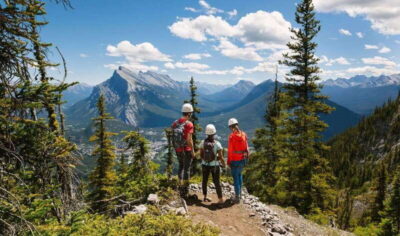
Banff: Mount Norquay 2.5 or 4-Hour Guided Via Ferrata Climb
Read our review →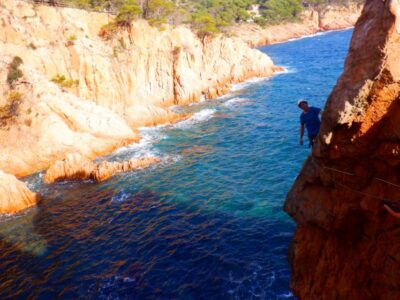
Sant Feliu de Guixols: Climb Via Ferrata Cala del Molí
Read our review →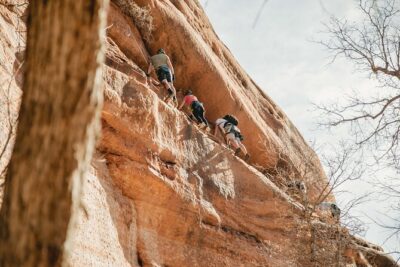
Small-Group Guided Via Ferrata Climbing with Banff’s Best Views
Read our review →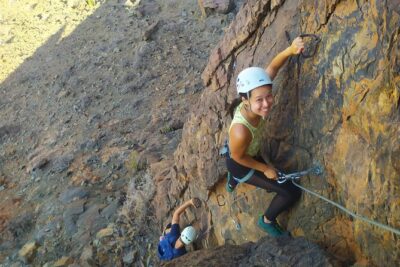
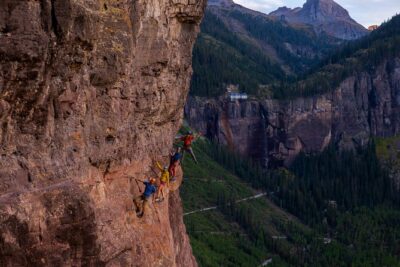
Via Ferrata in Gran Canaria. Vertical adventure park. Small groups
Read our review →Browse the lists this tour appears in